The UK Defence Investment Plan (DIP), published by UK Government on 30 June 2026, outlines the funding that will deliver the vision of the Strategic Defence Review (SDR) to equip the UK armed forces and keep our country safe.
The plan focuses on sovereign innovation and ingenuity to transform the Royal Navy, British Army and Royal Air Force (RAF) through new ways of procuring and developing cutting-edge technologies for delivery to the front line.
Leonardo stands ready to deliver this capability. With almost 10,000 highly skilled people working at ten sites across the UK, we are not only investing in future prosperity and skills, but also our national resilience.
Leonardo skills and expertise sit at the heart of UK Defence Investment Plan:
Leonardo sensor technology is a critical component of the RAF Typhoon’s Long-Term Evolution that will see the aircraft securing UK skies into the 2040s. The European Common Radar System (ECRS) Mk2 Active Electronically Scanned Array (AESA) radar is set to deliver new world-leading electronic warfare (EW) capability fully integrated with optimised and enhanced traditional radar functions. Our Joint Avionics Service – under the ‘Typhoon Total Availability eNterprise’ (TyTAN) – underpins the RAF Typhoon’s operations at home and overseas, by improving aircraft availability while reducing the costs of operating the fleet by more than a third.
Leonardo is a founding partner of Team Tempest – a UK partnership formed to generate the technologies and sovereign skills required for the UK to lead in the development of a next generation combat air system, including the 6th generation fighter jet being developed by the trinational Global Combat Air Programme.
The RAF’s StormShroud autonomous collaborative platforms (ACPs) will fly alongside 4th and 5th gen aircraft to confuse and suppress enemy radars during air combat missions. These ACPs are equipped with BriteStorm, Leonardo’s world-leading EW payload which deceives an enemy’s Integrated Air Defence System (IADS), degrading their ability to find, track and engage allied aircraft.
Designed and built by Leonardo in Yeovil, Proteus is the UK’s first fully autonomous full-size helicopter. Proteus was delivered through the UK Royal Navy’s Spearhead Anti-Submarine Warfare programme and has demonstrated the potential of large uncrewed air systems operating alongside crewed aircraft in future hybrid air wings to play a key role in anti-submarine operations, as part of the Atlantic Bastion programme.
Working in collaboration with some of the UK’s most innovative SMEs, Leonardo’s Sovereign Hunter trials are demonstrating the potential of swarming drones to deliver mission-level autonomy.
As the Royal Navy transitions to a hybrid force, Leonardo sensor integration capability is helping this approach become a reality. Leonardo has recently worked with UK SME, SubSea Craft, pairing an open digital platform with the company’s MARS USV to autonomously detect threats as part of ASW missions and helping operators make faster and better-informed decisions.
Proteus has also demonstrated an ability to perceive its environment, make decisions and act independently, delivering on the SDR’s vision for a Hybrid Navy and securing the North Atlantic.
Leonardo is a member of the UK DragonFire consortium – led by MBDA and comprising Leonardo and QinetiQ. The consortium brings together the best of relevant UK industry expertise to develop a Laser Directed Energy Weapon (LDEW) Capability Demonstrator Programme (CDP) on behalf of the UK Ministry of Defence.
Leonardo is providing the system's beam director which is designed to protect warships from aerial threats like drones and missiles. It is due to be delivered to Royal Navy Type 45 destroyers from 2027.
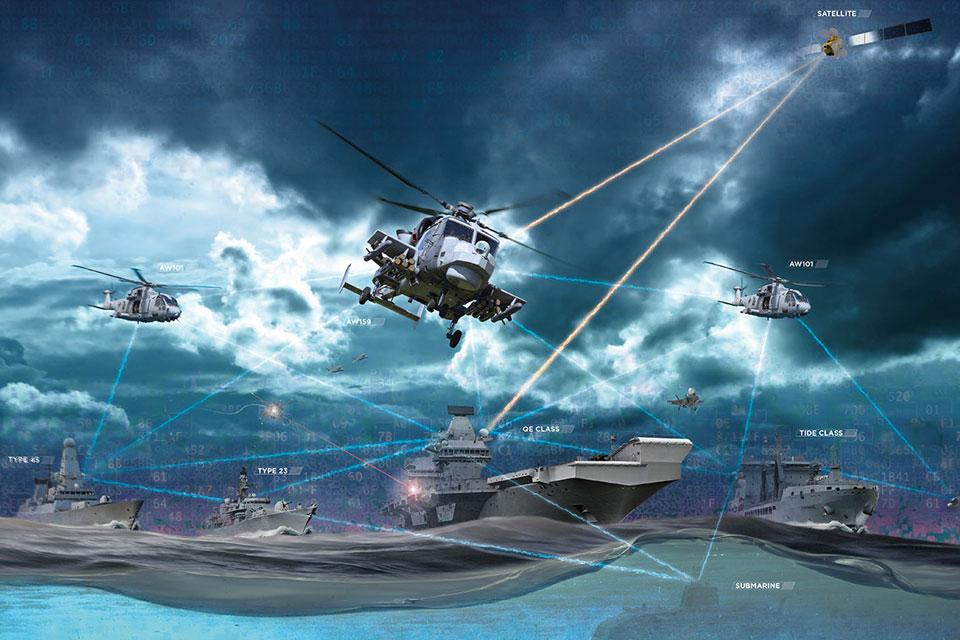
The Digital Targeting Web, unveiled in the SDR, is seen as critical for Leonardo. The DIP commits £1.8bn investment to it. This will connect sensors, deciders and effectors across the Integrated Force, underpinned by world-leading AI and software.
Additionally, the DIP promises “at least £1.3bn in a hybrid fleet”, some of which will be invested in cyber security including the Maritime Fighting Web, and a further £2.5bn for Cyber and Electromagnetic Activities (CEMA) – an area in which Leonardo has a long heritage of successfully delivering training, technologies, equipment and systems integration to a wide variety of civilian and military end users in the UK and internationally.