



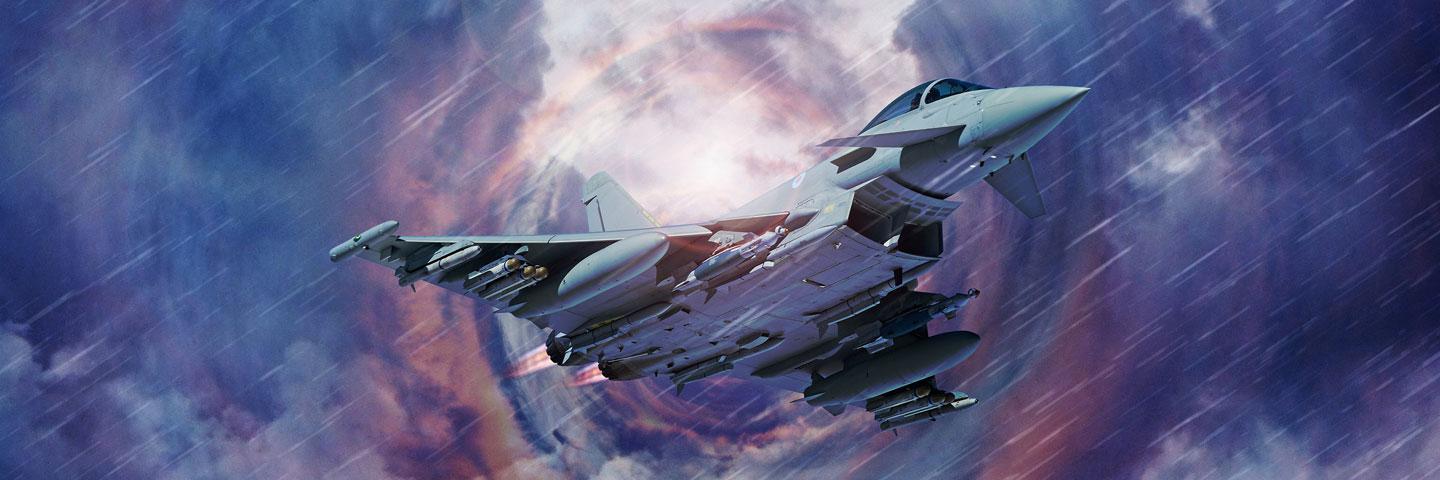


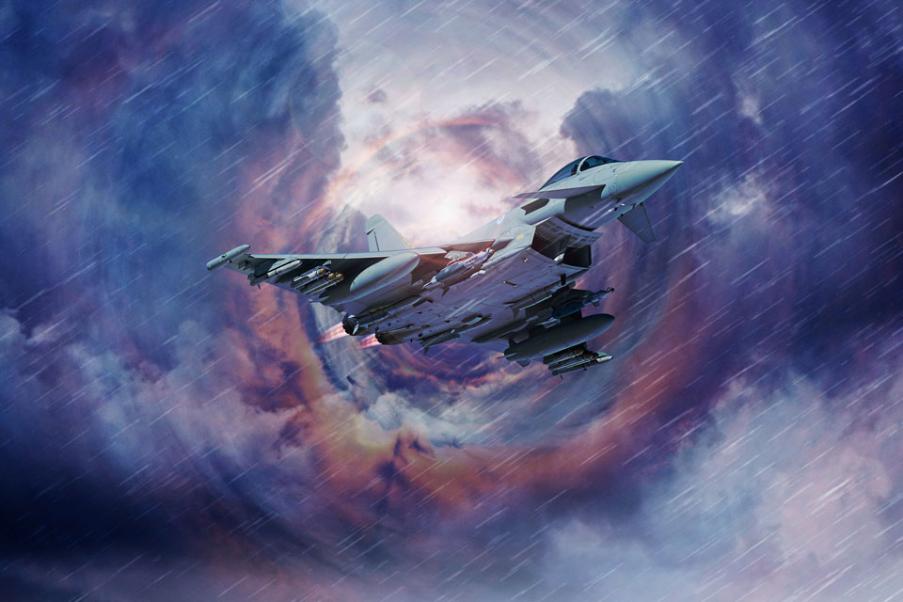
This evolution is clearly reflected in the growing fielding of advanced radar and missile systems as part of layered integrated air defence systems (known as IADS), which are highly effective area denial systems that can target aircraft and limit freedom of operations for friendly forces. Aircrew must operate in this complex, information-dense battlespace, often facing multiple simultaneous threats with limited time to respond.
In this environment, defensive aids systems on fighters play a critical role. Not as isolated subsystems, but as fully integrated capabilities that combine sensing, decision making and countermeasures into a coherent whole. This ensures that fighters remain operationally relevant, and their pilots are kept safe in increasingly saturated and contested airspaces.
For the Eurofighter Typhoon, that role is fulfilled by the Praetorian Defensive Aid Sub-System (DASS).
Cue the Praetorian guard
Since its inception, Praetorian has been the incumbent DASS on the Eurofighter Typhoon, delivering threat analysis, electronic support measures (ESM), electronic countermeasures and missile warning to pilots and their aircraft for a generation. Praetorian is fully integrated into the Eurofighter’s architecture, enabling a coherent and responsive defensive capability.
Praetorian provides pilots with 360-degree situational awareness, essentially a full spherical bubble around the aircraft. This is important because the DASS retains full coverage, detecting and tracking multiple simultaneous emitters, no matter whether the highly agile Typhoon is flying level or vertically, manoeuvring or rolling.
Detection alone, however, is not sufficient. The ability to rapidly identify and classify threats is critical to effective defensive action, with information presented in a way that supports rapid decision-making, reducing pilot workload, while maintaining operational clarity in complex scenarios. This understanding underpins the coordinated deployment of countermeasures, ensuring that responses are both appropriate and effective.
Praetorian combines on-board electronic countermeasures with off-board effects to deliver a layered response. Off-board effects include chaff, flares, towed decoys and BriteCloud. This integration ensures that defensive actions are not delivered in isolation, but as part of a coherent, system-level response.
A defining characteristic of today’s threat environment is concurrency. Aircraft must be able to manage multiple, potentially overlapping threats, often under conditions of saturation and ambiguity. Praetorian is designed to address this challenge, prioritising and coordinating responses across multiple threat types simultaneously. In doing so, it enables the aircraft to maintain mission focus whilst retaining a high level of survivability.
Underpinning this capability is EuroDASS, a multinational consortium of four leading European companies that have worked closely together for the past 30 years to develop and enhance Praetorian. This quartet of partners comprises Leonardo in the UK, Hensoldt in Germany, ELT Group in Italy, and Indra in Spain. They bring together deep, shared expertise in electronic warfare.
Evolving DASS for the latest threats
Praetorian has been on the Typhoon since the platform’s introduction into service, but it has been continually modernised as threats have evolved. This continuous evolution reflects a deliberate approach to maintaining operational relevance in an increasingly complex threat environment. The current configuration being implemented is known as Phase Three Enhancements, or P3E for short.
The P3E Praetorian package provides new software, firmware and hardware updates within the Typhoon’s current form factor. This latter point is particularly important, for Praetorian continues to retain the same size, weight and power (SWaP) factors as before.
The benefit is that the changes do not affect the aerodynamics, shape or balance of the jet, and the platform does not need to go through expensive and rigorous requalification of its flight profiles.
Sovereign ownership
With a growing number of Eurofighter operators across Europe and the Middle East, it is imperative that operators maintain sovereign control over their mission data. Praetorian enables each air force to generate, manage and adapt its own mission data, tailoring the system to reflect its specific operational environment and threat landscape.
Instead of awaiting international mission system updates, trained personnel can continually update their sovereign mission data at pace to match evolving threats. The result is a flexible approach that allows nations to develop and customise their own sovereign databases.
Staying relevant for the future
This commitment to continuous evolution is reflected in the ongoing development of P4E. This effort brings further advantages, whilst still fitting within the existing SWaP constraints and mould lines of the Eurofighter.
The P4E’s step change is its interoperability with European Common Radar System (ECRS) active electronically scanned array (AESA) radars, which are game-changing sensors for Eurofighter operators. It will also add frequency extensions and improved ESM capabilities. As a highly digitised system, it better handles data in more congested and contested environments.
The story of future warfare is not yet written, which is why a proactive EW system such as Praetorian is so important. Able to grow and update, it remains responsive to current and future threat environments.
Better still, Praetorian is agnostic to other architectures and upgrades within the Typhoon aircraft. Ultimately, Praetorian exists to ensure that aircrew can operate with confidence in the most demanding environments. By combining integrated sensing, intelligent threat understanding, and coordinated defensive effects, it helps protect both the aircraft and the mission.
Praetorian demonstrates how a mature, operationally-proven system can continue to evolve to meet the realities of modern air combat.