





The approach to countering an emerging electronic threat on the battlefield has often been lengthy: identify the threat; devise a solution to counter it; build the system; procure the product; and then deploy it. During the Cold War era, this process was sufficient because the pace of the threat and development of technology to counter it broadly matched.
However, with the onset of digital technologies and rapid innovation seen in recent conflicts, this has fundamentally changed. Today, an electronic threat can emerge, adapt and evolve in a matter of weeks. The traditional development and procurement frameworks simply cannot keep up, and the gap between identifying a threat and fielding a counter capability has become a vulnerability.
Guardian Vantage closes that gap.
Why Guardian Vantage exists
The possibility of a conflict with a peer or near-peer enemy has significantly increased in recent years, and the likelihood of that aggressor deploying advanced electronic systems is high. NATO nations and their allies will require advanced EW systems that can detect, intercept and analyse complex signals (known as signals intelligence, or SIGINT), and even deploy countermeasures, to ensure battlefield advantage.
The deployment of thousands of uncrewed systems – including remote-controlled one-way-attack (OWA) drones – across the modern battlefield is another contributor to an increasingly congested and contested electronic battlespace.
Since the end of the Cold War – especially during counter-insurgency conflicts where IEDs were the prominent threat for land forces – a common response to a new electronic or radio-controlled threat was to design, build and deploy a new system for the specific threat. The result was several different systems, and while they saved lives, they suffered from integration challenges, spiralling costs and lengthy reconfiguration processes.
Leonardo was there at the very genesis of the radio-controlled threat over 40 years ago and has extensive experience in devising electronic systems that can protect troops in contested environments. This has included protection from RF-triggered improvised explosive devices (IEDs), as well as newer threats such as drones.
It is this heritage and long experience – which has also included Leonardo’s role as a strategic partner for the UK’s airborne EW capabilities – that led our teams to devise innovative solutions that not only addressed current threats, but also the challenges associated with developing new EW systems at pace as threats emerge.
Informed by decades of operational experience and designed to break the lengthy identification-deployment cycle, Guardian Vantage is a direct result of 60+ years of Leonardo expertise and innovation, and importantly, it enables the return and strengthening of critical EW capabilities for land forces in NATO and beyond.
The importance of a modular architecture
Guardian Vantage is built to evolve at the same pace as the threats it is protecting against.
At its heart is an open modular architecture that is underpinned by established standards including the UK Ministry of Defence’s Standards for Integrated C5ISR/EW Systems (STICS), which allows individual components to be upgraded or swapped out without overhauling the entire system.
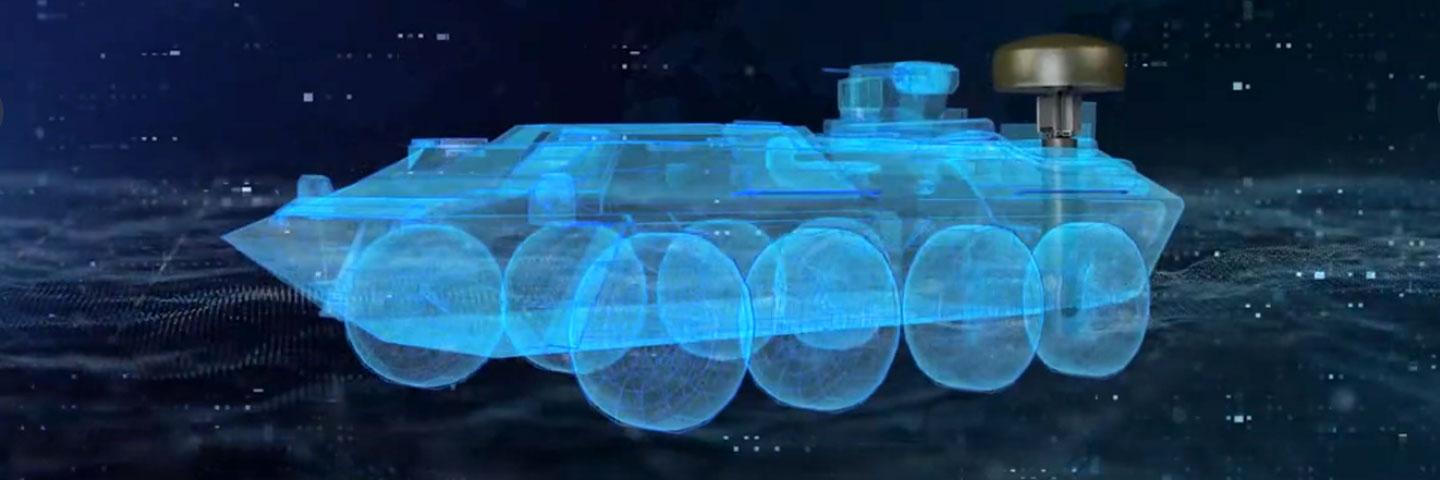
Built around an open chassis modified from the ‘Shield’ variant, Guardian Vantage can be Size, Weight and Power (SWAP) optimised for land platforms dependent on weight class, and quickly modified in the field. This means the operator can add or remove receivers and antennas, and change processing cards without requiring extensive vehicle modifications or requalification.
That modularity extends beyond just hardware. Guardian Vantage’s graphical user interface is already built to accommodate additional capabilities, including electronic attack. Adding them is simply a case of integrating the relevant hardware module.
And the system is scalable, allowing it to meet the performance levels required within platform constraints. It can be used singularly or with more than one unit mounted on a platform (for example, having one rack-mounted and one mast-mounted on a vehicle); and networked with other assets to build a broader intelligence picture. It can be integrated and networked with various UAS platforms to feed into a common operating picture.
“Guardian Vantage is an example of Leonardo leading in a rapidly evolving battlespace, giving armed forces the opportunity to evolve to an open architecture, where the vendor doesn’t control all of the interfaces.”
Mike Brown, Leonardo UK Campaign Manager for Land CEMA
Together, these capabilities add up to a fully adaptable, highly accurate system that covers the full spectrum of modern battlefield emissions – from HF through to 18 gigahertz and beyond – enabling detection and tracking of modern, frequency-agile, low-probability-of-intercept (LPI) communication systems used by near-peer adversaries. Its direction-finding accuracy is less than half a degree, compared to the two to three degrees typical of comparable systems.
And it does all of this sensing passively, without emitting a single signal in the detect phase.
Sovereignty, SMEs and a robust supply chain
The very nature of Guardian Vantage’s open architecture means that Leonardo, as well as end users and operators, are not restricted to having to use any single vendor for any single piece of hardware or software.
Instead, the system can be built and adapted using the best available commercial off-the-shelf or bespoke components for each part (as long as the components comply with the relevant standards). This is not just empty words; this approach has been tried-and-tested successfully with other Leonardo capabilities, including the operationally-deployed Falcon Shield counter-UAS system.
That freedom to choose best-in-class assets has led Leonardo to work with several different SMEs to build Guardian Vantage, with seven UK companies contributing components and expertise to the final system.
Access to defence procurement is not straightforward for smaller companies. The complex tendering process, the financial burden of trials and testing, and the depth of resources required, mean that operating in defence can often be beyond the reach of most SMEs.
Through projects like Guardian Vantage, Leonardo absorbs that risk as the integrator, providing the scale, experience and resources that smaller companies alone could not sustain, while actively bringing leading capabilities into the programme.
The result is a resilient, onshore supply chain with no single point of weakness, in which components can be sourced, upgraded or replaced competitively, adapting the system for performance, cost or availability as circumstances demand.
And because Guardian Vantage is completely ITAR free, operators have full freedom over the system, how it is used and who the data is shared with, without restriction or dependency on any third party. Guardian Vantage will also allow land forces to play a critical role in the wider SIGINT mission, something that has been left to exquisite, but vulnerable, airborne platforms in recent years.
Bridging the tactical land EW gap
Innovation and investment into tactical land EW had been largely deprioritised across Western forces since the end of the Cold War, but that is now changing.
Recent conflicts have brought this into sharp focus once more, demonstrating how personnel at Brigade and Battlegroup levels throughout NATO can deploy tactical land platforms or systems and fight effectively within the electromagnetic spectrum.
"Users want to find and defeat threats that exist now, but also be able to rapidly find new threats in the future."
Mike Brown, Leonardo UK Campaign Manager for Land CEMA
And that’s exactly what Guardian Vantage provides. It brings a level of capability previously associated with large, strategic platforms down to brigade and battlegroup level, right at the tactical edge where it is needed the most.
As an exportable, platform-agnostic, NATO standards-compliant and ITAR-free land EW solution, Guardian Vantage is built to evolve and not stand still. Users can effectively counter today’s threats, but also be ready for whatever comes next.