



In December 2018 during the busy holiday season, Gatwick Airport was forced to close after a series of drone sightings. These sightings were rightly taken seriously – a drone operating near or around an active airfield without clearance is a huge flight safety risk, including a collision with an aircraft and potentially loss of life.
The Royal Air Force (RAF) deployed their new Counter-Uncrewed Air Systems (C-UAS) capability – the UK military version of Falcon Shield, called ORCUS. The aim was simple: to restore airport operations as quickly as possible and prevent further disruption to travellers.
ORCUS was instrumental in monitoring airspace around the airport to reassure the Police and airport operations teams that there were no unauthorised drones in use. At the time, it was one of the first and most high-profile cases of disruption brought about by commercial, off-the-shelf drones.
Since 2018, ORCUS has been in high demand – both in the UK, where it has been activated on numerous occasions under Military Aid to the Civilian Authorities (MACA), as well as overseas on operations where it has protected the UK Armed Forces, and during deployments to high-profile events including the Paris Olympics.
The landscape has quickly evolved, with threat actors and nation states developing a range of Uncrewed Air Systems (UAS) and C-UAS capabilities at pace.
Leonardo has worked closely with the RAF and the operators of ORCUS, the RAF Regiment, throughout their journey with the system. This has included support to operations, recognised in 2024 when two Leonardo employees were awarded with the Operation Shader campaign medal, acknowledging their vital role in providing C-UAS protection.
Timeline of Events
ORCUS has been deployed both in the UK and overseas on many occasions since its inception. Here is a snapshot of deployments that have been reported in the press.
2026 – February to April: Deployments to the Middle East
It was widely reported that the UK deployed several ORCUS systems to the Middle East, to protect allies in the region from the threat of One-Way Attack (OWA) drones. Systems were deployed to RAF Akrotiri (Cyprus), Iraq and Kuwait.
2025 – Protecting civilian airports
- November 2025 – Belgium urgently requested the UK’s C-UAS expertise to protect Brussels Airport after drone sightings caused major disruption.
- October 2025 – Denmark requested the deployment of the UK’s ORCUS capability to protect two major European summits in Copenhagen.
2024 – Protecting bases and high-profile events
- June – ORCUS was deployed to protect commemorations on the 80th anniversary of the Normandy Landings.
- July-August – The French Government requested the deployment of ORCUS to protect the 2024 Summer Olympic and Paralympic Games in Paris. France24 quoted the French Prime Minister as saying that six drones a day were being intercepted.
- November – ORCUS was deployed to detect and track drones after multiple sightings near US bases in the UK.
2023 – Major public events protected by ORCUS
- May – The UK hosted the Eurovision Song Contest following Ukraine’s victory the previous year. ORCUS was called upon to provide counter-drone protection.
- May-June – ORCUS was deployed to protect key sites during the Coronation of King Charles III. The system also protected Trooping the Colour, held a month later.
2022 – Protecting high-profile events in the UK
- July-August – ORCUS was deployed to Birmingham for the Commonwealth Games, another example of the system’s civilian use under MACA (Military Aid to the Civilian Authorities).
- September – Following the passing of Queen Elizabeth II, ORCUS was deployed to protect key sites around the country involved with Op London Bridge, and the Queen’s state funeral.
2021 – Protecting the G7 Summit in Cornwall
- June – The RAF deployed ORCUS to the G7 Summit held in Carbis Bay, Cornwall to protect the high-profile event. G7 nations include the UK, Canada, France, Germany, Italy, Japan, and the US. The UK also invited Australia, India, South Korea and South Africa as guest countries.
2020 – Initial Operating Capability for ORCUS
- September – The UK Ministry of Defence announces ORCUS has reached Initial Operating Capability (IOC), confirming that the system will protect UK air bases from hostile drone activity. Defence Equipment & Support (DE&S) confirmed that further sub-systems would be integrated for testing and evaluation as ORCUS was developed.
2019 – Further sightings at Heathrow Airport
- January – Less than a month after the incident at Gatwick, Heathrow Airport suffered disruption after drone sightings brought arrivals and departures to a halt. ORCUS was used to detect and deter further drone activity, providing reassurance that the busy airport could resume operations.
2018 – Drone sightings at Gatwick Airport
- December – Travellers faced flight delays and cancellations after a series of drone sightings during the festive season. The RAF was deployed with an early version of ORCUS to detect and deter any further drone activity.
2012 – Operation OLYMPIC
- July-August – The original ORCUS system can be traced back as far as the 2012 Summer Olympics and Paralympic Games in London where it was operated by the Defence Warning and Reporting Flight. The system was procured under Project Synergia, the RAF’s research and development programme designed to test a full range of integrated detect, track, identify and defeat technologies.
ORCUS has featured in an episode about C-UAS on the RAF’s official podcast, InsideAir. During the episode, the system’s operator – the RAF Regiment – explains how its sensors and effectors are employed on operations.
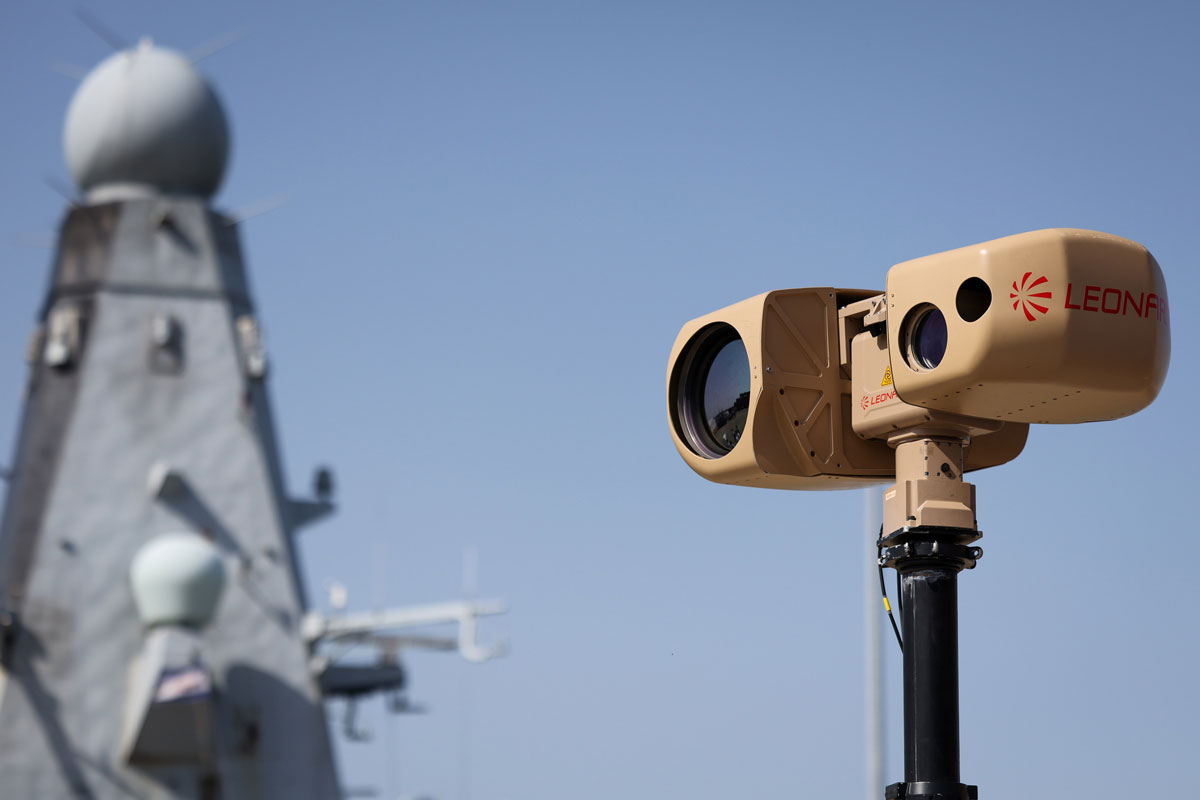 Central to this is Nerio ULR (Ultra-Long Range), which the RAF Regiment describes as “world-leading”, and capable of identifying what the radar and other systems have detected – a key part to positively identifying potential threats, and for creating an evidence trail.
Leonardo continues to develop Falcon Shield, constantly testing and integrating new and existing sensors and effectors so that our customers have the most amount of choice when creating their layered counter-drone system.
At the heart of this spiral development is the close working relationships we have with our customers – critical to ensuring our system is fit for purpose now, and into the future. Leonardo works closely with the RAF, at home and overseas, to enable the protection of our people, places and platforms – wherever they are in the world.